Thursday, May 08, 2014

FEVER WITH DELERIUM


1.  All of the following differentiate  DEMENTIA from DELERIUM except:
a) Long standing
b) Less volatility of symptoms
c) Unable to retain focus and attention
d) Can be progressive

2. All the following group are high risk for developing delirium due t elevated core temperature of body except:

a) Age >60
b) Females
c) structural brain disease
d) Polypharmacy
e) depression
f) surgery

3) Which is the most common type of febrile delirium in clinical settings :
a) Hyperactive
b) Hypoactive

4) All are true regarding hyperactive febrile delirium except:
a)Combative and uncooperative patient
b) though less common in number come to attention of doctor easily
c) common in bacterial CNS infection with sepsis
d) may need restrain and sedation

5)Pathophysiology of febrile delirium include:
a) increase in excitatory neurotransmitters
b) increase in inhibitory neurotransmitters
c) cerebralinflammation
d) cerebral edema, ischaemia nd metabolic dysfunction
e) raised ICT
f) seizures
g) all of the above

6) All are notorious for rhombencephalitis except:
a) Listeria
b) Mycobacterium tuberculosis
c) Lymes borreliosis
d) Toxoplasma
e) Lymphoma
f) VZV
g) Rabies
h) Brucellosis
I) Paraneoplastic syndrome

MCQS WITH ANWERS AT $6, BUY WITH PAYPAL
 

Tuesday, May 06, 2014

Update on breast diseases for the internist


      MCQs on Update on breast diseases for the internist
  1. Which are the red herring features of breast malignancy in a patient presenting to you with a suspicious mass of breast on self palpation:
           a) Family and personal history of breast or ovarian cancer
           b) Prior breast biopsy report of atypical hyperplasia
           c) Early age of menarche
           d) Early age at parity
           e) All of the above

     2.   The investigation of choice for a suspected mass of breast on palpation is/are:
           
            a) Bilateral mammogram
            b) targeted Ultrasound of the breast
            c) Both
            d) None of the above

     3. All statements are true except :
   
             a) Asymmetric density and pleomorphic calcifications in mammogram is highly  suspicious
                 of malignancy
            b) A normal mammogram in a obese lady with a discrete breast mass is an encouraging report
            c) Thin walled fluid filed cysts are likely to be benign
            d) Complex thick walled cysts in USG breast should be biopsied

    4.  Red herring signs of breast malignancy in mammogram are :
          
            a) Pleomorphic calcifications
            b) Asymmetry
             c) Architectural distortion
             d) Thick walled cysts
    5.  Short interval follow up of patient is required in which grade of mammogram (BIRADS)

          a) 1
          b) 2
          c)  3
          d) 4
          e) 5
 
   6 . Causes of  haemmorhagic nipple discharge are all except :
         a) ductal ectasia
         b) ductal papilloma
         c) periductal mastitis
          d) malignancy
         e) prolactinoma

  7.  Mondors disease is thrombosis of which vein:

     a) Mammary veins
     b) Cephalic vein
     c) thoraco epigastric veins
     d) brachiocephalic veins


Buy the MCQ set with answers for $ 7..File will be send as an email in 2-3 working days


Tuesday, February 06, 2007

All India Pre-PG entrance(AIPPG) Jan 2007: Medical subspecialities

1.Non Specific Esterase(NSE) is seen in which type of leukaemia:
a.) AML 3
b.) AML 0
c.) ALL
d.) All of the above.

Answer ( C ). Ref - Robbins. Explanation: Non specific esterases are produced by cells with leukocytic differentiation. Only AML4 (others as AML3,4,5) has the criteria fulfilled. AML0 has no differentiation, AML 6 is erythrocytic and AML 7 is megakaryocytic but has nearly 40-50% of myeloblasts so it can be NSE posititve.. So the Answer is (C).

2. True about BCG vaccine is:
a) Danish 1331 strain.
b) Diluent is distilled water
c) Spirit is used for cleaning the area.
d) It prevents adult tuberculosis.

Answer A: Ref -Park and Park.Explanation. BCG is a live attenuated vaccine produced by Danish 1331 strain of My.Bovis attenuated by 239 serial subcultures in glycerine-potato medium over 13years. It is included in UIP given at birth,the freeze dried powder is made into a 0.5ml intrademal injection reconstituted with sterile normal saline,over left deltoid in the upper 1/3 after cleaning with distilled water avoiding spirits and antiseptics. It oes not prevent adult TB(secondary TB) due to immunfailure.BCG protects from TB meningitis and military TB only.

3.A child has TGA the mother has to be investigated for:
a) Maternal diabetes
b) PIH
c) Heart diseases

Answer: A.

4. Which of the following retinal diseases is transmitted as Autosomal dominant disorder:
a) Best disease
b) Gyrate atrophy
c) LMB

Answer: (A). Ref Yanoff Best disease (vitelliform macular degeneration) is a rare autosomal dominant disorder (Chr. 11q13), with macular degeneration presenting as “yellow egg yolk” like appearance of macula due to lipofuschin accumilation. ERG shows reduced ‘C’ wave.Gyrate atrophy is ornithine tranferase deficiency.Autosomal recessive inheritance Chr 10q.


5. Which of the anticancer drug causes hyperviscosity syndrome:
a) Vinblastine
b) L-Asparaginase
c) 5-FU
d) Methotraxate.

Answer B. Reference Tripatti. L-Asp is derives from E.coli,it is specifically used in ALL,devoid of normal side effects of anticancer drugs as NO ALOPECIA,NO LECOPENIA,NO MUCOSAL DAMAGE. Remmember L-ASP(Leucopenia,Alopecia,Skin and mucosalloss Prevented). It causes liver damage,hyperviscosity,pancreatitis and CNS symptoms.

6. Chemotherapeutic agent producing SIADH is:
a) Vincristine
b) 5-FU
c) Cyclophosphamide
d) Bleomycin
e) Gemcitabin

Answer: A&C . Ref Harrison. Explanation- SIADH producing drugs are : Vasopressin,oxytocin,Chlorpropamide,Vincristine,cyclophosphamide,Carbamezapine,Phenothiazine,MAO inhibitors,SSRI’s,TCA’s,Nicotine.

7.Leprosy affects all exept:
a) Uterus
b) Ovary
c) Testes
d) Eyes
e) Nerves

Answer A&B. Ref Harrison. Explanation.

8. Which of the following is least useful in multiple myeloma:
a) X-ray
b) Urine protein
c) Bone scan
d) Bone marrow biopsy

Answer C. Bone scan as there is no new bone formation so ALP is also normal.

9. Cat eyes syndrome is seen in:
a) Partial Trisomy 21
b) Partial Trisomy 22
c) Partial Trisomy 13
d) Partial Trisomy 5
Answer A. Reference Nelson. Partial trisomy 21 causes Cat eye syndrome while Total trisomy 21 causes down’s syndrome. Cat eye syndrome is associated with total anomalous venous return.

10. Finding in chronic DIC include all except:

a) Increaded fibrinogen,antithrombin III and thrombin antithrombin complexes.
b) Increased FDP and antithrombin III and decreased PT.
c) Increased FDP,PT and thrombin antithrombin complexes.
d) Increased FDP,PT and Platelets.

Answer B. Reference Harrison. Explanation
Findings in chronic DIC (thrombosis as DVT and SVT predominates) are:
Modestly increased Prothrombin time(PT).
Shortened or lengthened partial thromboplastin time(PTT)
Normal thrombin time mostly.
High,normal or low fibrinogen.
High,normal or low Platelets.
Increased FDP.
Increased markers of DIC as thrombin antithrombin complexes,Prothtrombin fragment F1+F2 and activation marker on platelets.
Note in acute DIC PT,APTT is prolonged and Fibrinogen,Platelets are decreased and FDP is increased and peripheral smear shows schistocytes.

11. Which of the following is not true of Vibrio O139:
a) Produce disease indistinguishable from O1
b) Polysacharride capsule
c) Isolated from chennai
d) Replaced El tor as 8th epidemic in 1992.

Answer: C.Ref Harisson. Explanatio it is isolated from Bengal in 1992.

12. Not true of vibrio cholerae:
a) Non halophilic
b) Grows in ordinary culture
c) Survives well outside body

Answer C.

13. A patient is in septicaemic shock which vasopressor is useful:
a) Epinephrine
b) Norepinephrine
c) Phenylephrine
d) Ephedrine
Answer : B
PayPal Acceptance Mark

Thursday, May 04, 2006

Hepatology: Portal hypertension

1. Portal vein is about:
a) 1cm
b) 5cm
c) 10cm
d) 15cm

2. Portal hypertension is diagnosed when pressure is:
a) >10cm of water
b) >12 mm of Hg
c) >30mm of Hg
d) >30 cm of water
e) Both A and C
f) Both B and D

3. Tributaries of left portal vein are all except:
a) Paraumblical vein
b) Ligamentum venosum
c) Ligamentum teres
d) Cystic vein


4. Grade III varix in OGD means that:
a) Varices are easily compressible
b) Varices are not compressible
c) Confluent varices at lower GE junction

5. Which of the following statements is wrong:
a) Azygous vein forms caval and left and short gastric veins form portal components of esophageal PS shunts
b) Superior rectal vein forms caval and and middle and inferior rectal veins form portal components of PS shunts in rectum
c) Paraumblical veinn drains in to the left branch of portal vein directly.

6. USG wise the following are suggestive of PHTN except:
a) Splenomegaly
b) Collaterals
c) Ascites
d) Portal vein of diameter 1cm

7. Cardiac cirrhosis is charecterised by all except:
a) Raised JVP
b) Hepatomegaly
c) Non pulsatile liver with TR
d) Numerous collaterals in USG
e) Ascites

For answers and subscription contact drjitheshk@gmail.com

Wednesday, May 03, 2006

Hepatology: Liver function tests

1. SGOT/SGPT in an alcoholic patient is >2 because:
a) SGOT is excessively released in alcoholic hepatitis
b) SGPT is poorly synthesized due to pyridoxine deficiency
c) Alcohol induced change in enzyme synthesis
d) Observation is an artifact due to interference of alcohol with SGPT estimation

2. GGT/ALP ratio diagnostic of alcohol induced liver injury:
a) 1
b) 1.5
c) 2
d) 2.5
e) 3
f) 3.5

3. GGT is synthesized from all except:
a) Liver
b) Pancreas
c) Kidney
d) Heart
e) Biliary tract
f) Lungs
g) Spleen

4. An alcoholic after binge drinking is referred to you with his PT>16s and S.Bilirubin>5mg/dl, and Albumin>3 gm/dl, your comment as a hepatologist is that:
a) Discrimination index is 60, his prognosis is good.
b) Discrimination index is 70,his prognosis is good
c) Discrimination index is 60,prognosis is bad
d) Discrimination index is 70,prognosis is bad

5. All the following are synthesized in liver except:
a) Prothrombin
b) Alpha 1 antitrypsin
c) Anti hemophilic factor
d) Gamma globulins

6. All the following helps to determine the biliary origin of ALP except:
a) GGT
b) Amino peptidase
c) 5’- Nucleotidase
d) LDH-1
e) Bilirubin

For subscriptions and answers contact drjitheshk@gmail.com

Sunday, April 30, 2006

Pulmonology: Tuberculosis and DOTS

1. Cerebral tuberculosis focus is called
a) Simmond’s
b) Simmons
c) Richs
d) Wigard’s

2. Which of the following are seriously ill TB patients except:
a) Pericardial
b) Bilateral pleural
c) Peritoneal
d) GIT
e) Pott’s disease
f) TB osteomyelitis of long bones
g) Genitourinary

3. All the following second line TB drugs are bacteriocidal except:
a) Capreomycin
b) Cycloserine
c) Kanamycin
d) Thiacetazone

4. Time interval for occurance of genitourinary TB after primary infection is:
a) 1-2 yrs
b) 5-15 yrs
c) 20-30 yrs
d) >50 yrs

5. Live TB bacteria is identified by:
a) Sputum smear
b) BACTEC
c) PCR
d) ELISA

6. Wigard’s focus is infection of TB of:
a) Brain
b) Hilar LNE
c) Eye
d) Endothelium

7. Treatment default is for:
a) >1 month
b) >2 months
c) >3months
d) >4 months

8. Class IV DOTS regimen is for:
a) Relapse
b) MDR
c) Chronic cases
d) HIV patients

9. A chronic case of TB is diagnosed when:
a) Sputum positive after 5 months of ATT
b) Sputum positive after retreatment for treatment failure
c) Patient who has sequelae and TB focus sfter ATT
d) Immunosuppressed patient with positive sputum

10. A Class I DOTS patient after 3 months of ATT was subjected to sputum examination was found to be positive then you will:
a) Diagnose chronic TB
b) Diagnose MDR TB
c) Continue ATT for 1 more month and repeat sputum examinatio
d) Diagnose treatment failure

for answers and subscription contact drjitheshk@gmail.com

Friday, April 28, 2006

Pulmonology: Lung collapse


1. In collapse the changes are:
a) Reduction in lung volume but normal air volume
b) Reduction in both air and lung volume
c) Increase in air but decrease in lung volume
d) Increased lung and air volume.

2. Decrease in air volume but normal lung volume occurs in:
a) Fibrosis
b) Collapse
c) Consolidation
d) Emphysema

3. The direct sign of collapse in X ray is:
a) Mediastinal shift
b) Crowding of ribs,blood vessels and bronchi
c) Hyperdensity with loss of aeration
d) Shifting of interlobar fissures

4. In active collapse all are true except:
a) Intrapleural pressure in negative
b) Trachea is pushed to opposite side
c) Oppsite lung is emphysematous
d) No chest bulging on same side

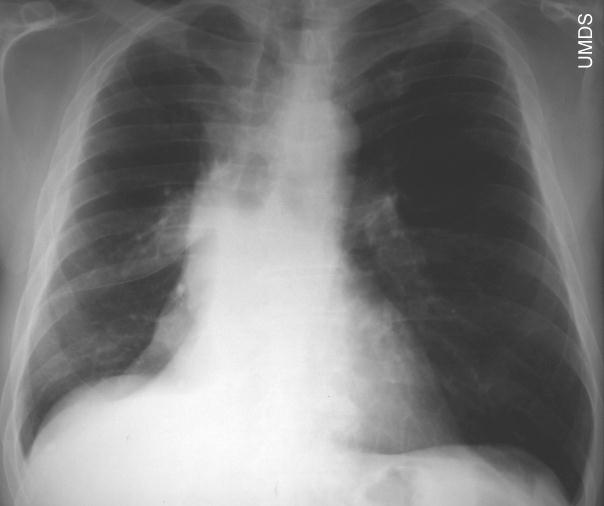
5. Which lobe is collapsed in the x ray enclosed:
a) Rt Middle lobe
b) Rt Lower lobe
c) Rt upper lobe
d) Posterior segment of Rt upper lobe

for answers and subscription contact drjitheshk@gmail.com

Thursday, April 27, 2006

Pulmonology: Lung cavity

1. Thick walled cavity is seen in all except:
a) Wegeners granulomatosis
b) Adeno- carcinomas
c) Tuberculosis
d) Fungal infection

2. Bleb is defined as:
a) Diameter>1cm and wall <1mm
b) Diameter <1cm>1 mm
c) Diameter >1cm and wall>1mm
d) Diameter <1cm and wall<1mm

3. Shaggy border is seen in:
a) Wegeners granulomatosis
b) Lung abscess
c) Hydatid cyst
d) Bronchogenic carcinoma

4. Cavity is:
a) Lined by epithelium
b) Has no epithelial lining
c) Wall thickness <1mm
d) Tuberculosis causes thin walled cavities

5. Signs of a superficial collapsible and communicating cavity are all except:
a) Cavernous breathing
b) Amphoric breathing
c) Crackpot sign
d) Post tussive suction

6. The sign of an empty cavity is:
a) Post tussive suction
b) Crackpot sign
c) Cavernous breathing
d) Drop sound

for answers and subscription contact drjitheshk@gmail.com

Pulmonology: Chest wall deformities

1.Normal AP:TD ratio is:
a) 5:7
b) 3:4
c) 5:9
d) 1:2

2. Pthnoid chest has a APD:TD ratio of atleast:
a) 1:2
b) 3:4
c) 2:1
d) 7:5

3. Pomphret’s heart is seen in:
a) Pectus carinatum
b) Pectus excavatum
c) Pthnoid chest
d) Alar chest
e) Flail chest

4. Painful chest deformity is:
a) Rickety rosary
b) Scorbutic rosary
c) Alar chest
d) Pthnoid chest

5. Normal subcostal angle is _____________ O:
a) 90-110
b) 120-140
c) 140-160
d) 160 onwards

for answers and subscription contact drjitheshk@gmail.com

Pulmonology: Auscultation

1. Normal vesicular breath sound has a frequency of :
a) 15-200 Hz
b) 200-600Hz
c) 20-2000Hz
d) Variable

2. In vesicular breath sound the I:E ratio is:
a) 1:3
b) 3:1
c) 4:1
d) 3:2

3. All the following are predominantly low pitched except:
a) Vesicular BS
b) Cavernous BS
c) Tubular BS
d) Amphoric BS

4. Amphoric BS is heard in all except:
a) Bronchopleural fistula
b) Tension pneumothorax
c) Large superficial communicating cavity
d) Collapse with patent bronchus

5. Clinical description of Breath Sounds was given by:
a) Laenac
b) Sapira
c) Goll
d) Edmondo

6.All are true regarding crepitations according to ATS definitions except:
a) Non continous
b) Non musical
c) Explosive
d) Duration >250ms
e) Duration <250 ms

7. Al the following are late inspiratory crepitations except:
a) Idipopathic pulmonary fibrosis
b) Bronchiectasis
c) Lupus lung
d) Asbestosis

8. ILD shows which added sounds:
a) Squawks
b) Expiratory wheeze
c) Fixed monophonic wheeze
d) Coarse crepitations
e) Death rattle

9. All the following differentiate rub from crackles except:
a) Discontinous
b) Superficial
c) Cough variation
d) Tenderness
e) Non segmental

10. De espine sign is positive in all except:
a) Central pneumonia
b) Mediastinal lymphoma
c) Thymoma
d) Mediastinal neuroblastoma

for answers and subscription contact drjitheshk@gmail.com

Pulmonology: Percussion

1. Normal percussion has a frequency of :
a) 140Hz
b) 240Hz
c) 640Hz
d) 1400Hz

2. A treatise on the clinical interpretation of percussion was given by:
a) Sapira
b) Auenbrugger
c) Christopher
d) Koch

3. Auenbrugger’s father was a:
a) Percussionist
b) Brewer
c) Sewer
d) Tailor

4. Stony dullness is heart in all except:
a) Pleural effusion
b) Empyema
c) Pleural thickening
d) Parenchymal disease with pleursal thickening

5. The following are cardinal rules of percussion except:
a) Movements should arise from wrist
b) Move from abnormal to normal areas of percussion note
c) Direct percussion should not be done outside medial 1/3 of clavicle
d) Lesions more than 5cm below cannot be detected

6. Percussion myokymia is seen in:
a) Myotonia
b) Paraneoplastic manifestations
c) Wasting PTB
d) All of the above.

7. Tidal percussion is positive in all except:
a) Liver mass
b) Subdiaphramatic absecess
c) Normal
d) Diaphramatic paralysis

8. Barkun’s method is the percussion for:
a) Kornigs isthmus
b) Traubes space
c) Splenic percussion
d) Direct percussion of clavicle

9.Traube’s area is dull in all conditions except:
a) Splenomegaly
b) Left pleural effusion
c) Lung mass on Left side
d) Full stomach
e) Achalasia cardia
f) Situs inversus

10. During crack pot elicition :
a) Keep the mouth of pt. Open
b) Keep your mouth open
c) Percuss with a knee hammer
d) Use direct percussionKeep both your mouths open

For answers and subscription contact drjitheshk@gmail.com

Pulmonology: Clubbing

1.Lovibond’s sign is:
a) Cyanosis
b) Clubbing
c) Edema
d) Crepitations

2. Angle beyond which you will say there is definite clubbing:
a) 160
b) 180
c) 200
d) 210

3. Pachydermatoperiosteitis (Congenital/Touraine solente gole syndrome) is known to spare:
a) Index finger
b) Thumb
c) Little finger
d) Big toe

4. Pseudoclubbing is seen in all except:
a) Hansens disease
b) Vinyl chloride workers
c) Hyperparathyroidism
d) Leukaemia
e) Mesothelioma

5. Which of the following is not a suspected cause for clubbing:
a) Neurogenic
b) PTH
c) PG
d) PDGEF
e) GH
f) Insulin
g) Hypoxia
h) Ferrirtin

6. Unilateral clubbing is seen n all except:
a) Hemiplegia
b) Pancoast syndrome
c) Brachial AV fistulas
d) PDA
e) Anuerysms of subclavian artery

7. In which finger does clubbing occurs first:
a) Index finger
b) Thumb
c) Bigtoe
d) Little finger

8.Unidigital clubbing is seen in:
a) Trauma
b) Gout
c) Sarcoidosis
d) All of the above

9. Acute clubbing is clubbing occurring in:
a) 1-7 days
b) 7-10 days
c) 10-14 days
d) 21-30 days

10. In Parrot beaking or Gr III clubbing there is :
a) Increase in both AP and Transverse diameter
b) Increase in AP diamter alone
c) Increase in transverse diameter alone
d) Whole distal phalanx is enlarged

for answers and subscription contact drjitheshk@gmail.com

Wednesday, April 26, 2006

Pulmonology: Bronchopulmonary segments

1. Which BP segment is absent in left lung and what percentage:
a) Lateral basal segment (90%)
b) Lateral basal segment (80%)
c) Medial basal segment (90%)
d) Medial basal segment (8%)

2. Which of the following is not exclusive of BP segments:
a) Pulmonary arterial branches
b) Bronchial arterial branches
c) Pulmonary veins
d) Bronchial veins
e) Tertiary bronchus

3. Kornigs isthmus overlies:
a) Apical BP segment
b) Medial basal apical seg ment
c) Lateral beasl medial segment
d) Posterior segment

4. Secondary pulmonary TB commonly affects which BP segment
a) Apical
b) Posterior
c) Anterior
d) Anterior basal

5. Which BP segment is contigous with arch of aorta:
a) Medial BP segment of middle lobe Rt
b) Superior segment of Lingula
c) Anterior segment Lt lung
d) Posterior segment in Lt. Lung

For answers and subscription contact drjitheshk@gmail.com

Tuesday, April 25, 2006

Cardiology: Myocardial infarction

1.Mortality in killips class III :
a) 10-20%
b) 30-40%
c) 80-90%
d) 100%

2. Accelerated idioventricular rhythm in MI is a :
a) Ventricular ectopic
b) Atrial ectopic
c) Heart block
d) None of these

3. Heart rate in Accelerated idioventricular rhythm is__________(beats/min),if his SA node is beating at 60-100/min:
a) 60-100
b) 100-120
c) >140
d) >160

4. The following are studies on MI treatment except:
a) TIMI
b) GUSTO
c) AIRE
d) ALLHAT
e) PROGRESS

5. All indications of Permanaent pacemeaker in MI except:
a) Wenckebach
b) Mobitz type II
c) Third degree heart blocks in AWMI
d) Sick sinus syndrome

6. Post MI myocardial ruprure is common in all except:
a) Males
b) Hypertensives
c) Female
d) First week
e) Fourth week
f) Both a,e
g) Both c,e

For anwers and subscription contact drjitheshk@gmail.com

Cardiology: Echo for Physicians


1.Pioneering works in ECHO was done by:
a) Angle
b) Edler
c) Frossmann
d) Christopher

2. Typical frequency produced by an ECHO is:
a) 1 MHz
b) 2.5 MHz
c) 5 MHz
d) 20MHz

3. Which of the following structures are poorly visualized by TEE:
a) Mitral valve
b) Aortic valve
c) Left atrium
d) Left ventricle

4. What is the defect in the ECHO attached:
a) Aortic aneurysm
b) Ventricular aneurysm
c) Aortic dissection
d) RWMA

5. Indication/s of TEE in IE is/are except:
a) One major dukes criteria but normal TTE
b) Two minor dukes criteria but normal TTE
c) Vegetation in TTE itself
d) Suspected aortic valve abscess
e) Prosthetic valves
f) All patients suspected of IE

6. The best semi quantitative assessment of RV function is:
a) Pulmonary valve movements
b) Tricuspid annulus movements
c) Pulmonary Doppler flow assessment
d) Right atrial dilatation

7. Mc Connels sign in ECHO is seen in:
a) PAH
b) Tricuspid regurgitation
c) Pulmonary embolismIE

Cardiology: Sgarbossa's criteria


1. Cabrera’s sign refers to :
a) Slurring of ascending limb of S wave >0.05s in V3,V4.
b) Slurring of the ascendind limb of R wave >0.05s in I,aVl,V5-6
c) Extreme left axis deviation
d) ST elevation >1mm in two contigous leads.

2.Which is most diagnostic of all of MI in LBBB:
a) Slurring of ascending limb of S wave >0.05s in V3,V4.
b) Slurring of the ascendind limb of R wave >0.05s in I,aVl,V5-6
c) Extreme left axis deviation
d) ST elevation >1mm in two contigous leads.

3. Patients studied for sgarbossa’s criteria was from the following study:
a) TIMI
b) GCCT
c) GUSTO
d) UKPDS
e) LIVE

4. Is chapman’s sign present in the ecg enclosed:
a) NO
b) YES
c) Cannot determineOnly cabrera’s sign is present

For an article on Sgarbossa's criteria in CMU go to clinicalmedicineupdate.blogspot.com or clink on link in side bar
For answers and subscription contact drjitheshk@gmail.com

Cardiology: Pulmonary hypertension

1.First sign of pulmonary venous hypertension in CXR is:
a) Cephalisation of pulmonary veins
b) Kerly B lines
c) Kerly A lines
d) Batwing appearance

2.Pulmonary hypertension is present if pulmonary MAP is at least:
a) 10
b) 15
c) 20
d) 30

3. In CXR hilar to thoracic ratio of at least ____________ is suggestive of PAH:
a) 0.34
b) 0.44
c) 0.54
d) 0.64

4. In CXR the diameter of first descending pulmonary artery should be atleast_______for diagnosis of PAH:
a) 12
b) 13
c) 14
d) 15
e) 16

5. In which condition is pulmonary hemosiderinosis seen:
a) Primary PAH
b) Secondary PAH
c) Pulmonary venoocclussive disease
d) Haemochromatosis

6.What type of cyanosis is common in PAH:
a) Central
b) Peripheral
c) Pigmentary
d) None of these

7.In a patient with PAH, with regular pulse shows absent “a” wave in JVP it indicates:
a) RAF
b) LAF
c) LVF
d) RVF
e) Pulmonary embolism

8. Which produces maximum rise in PAP:
a) Acute pulmonary embolism
b) Chronic pulmonary embolism
c) Maladie de roger
d) Tricuspid stenosis

9. Pulmonary edema occurs when PVP is atleast:
a) 10
b) 15
c) 25
d) 30

10. Mean survival of patients with Primary PAH is :
a) 1.8 yrs
b) 2.8 yrs
c) 3.8 yrs
d) 4.8 yrs

For answers and subscription contact drjitheshk@gmail.com

Cardiology: Infective endocarditis

1.The composition of vegetation includes:
a) Fibrin
b) Platelet
c) Microorganism
d) Inflammatory cells
e) All of the above

2.Dukes criteria for diagnosis of IE was published in:
a) 1900
b) 1985
c) 1994
d) 2000

3.Fever of IE is typically absent in patients with:
a) CCF
b) Diabetes
c) CRF
d) Liver failure
e) Previous Rx with antibiotics
f) Less virulent organisms
g) All of the above

4. The best predictive sign of myocardial abscess in IE of aortic valve is:
a) Tachycardia
b) Ejection systolic murmur
c) S3 of LV
d) ECG showing new onset AV block

5. Duke criteria is based on a/an:
a) Physician
b) Patient
c) Hospital
d) University

6.Emboli of IE commonly affect in the following order:
a) Kidney>spleen>liver>mesenteric arteries
b) Mesenteric arteries>liver>spleen>kidney
c) Spleen>kidney>liver>mesenteric arteries
d) Liver>spleen>kidney>mesenteric arteries

7. Drug of choice for HACEK organisms in IE:
a) Vancomycin
b) Ceftriaxone
c) Ampicillin
d) Metronidazole

8.The strongest indication for surgery in IE is:
a) Persistence of fever
b) Septic embolism
c) Congestive cardiac failure
d) Perivalvular invasive disease

9. All are true regarding Libman sach’s endocarditis except:
a) Seen in ventricular surface of valves
b) Multiple
c) Commonly affects aortic valve than mitral valve
d) Recur after valve replacement

10.Roth spots are seen in :
a) IE
b) Leukaemias
c) Scurvy
d) Aplastic anaemia
e) All of the above

For answers and subscription contact drjitheshk@gmail.com

Cardiology: Heart diseases in Pregnancy

1.Cardiac output and blood volume is maximum during ___________ weeks of pregnancy:
a) 12-14 weeks
b) 20-24 weeks
c) 30-32 weeks
d) At delivery

2.Haemodynamic changes regress to normal after __________ weeks of delivery:
a) 1-2
b) 2-4
c) 4-6
d) 6-8

3. Echocardiogram is indicated when the following are detected in pregnancy except:
a) Diastolic murmur
b) Continous murmur
c) Gr 2 systolic murmur
d) ECG abnormalities

4. A healthy female with RHD MS/MR at the time of hospital vaginal delivery should:
a) Receive Infective endocarditis prophylaxis.
b) Shall decide after a predelivery ECHO for IE prophylaxis
c) No need for IE prophylaxis if there are no features of infection
d) Shall do a cardiology consultation

5. If a patitent needs BMV during pregnancy , ideal timing is:
a) First trimester
b) Second trimester
c) Third trimester
d) Before delivery

6. A female in first trimester with congenital AS with transvalvular gradient >50mm of and LVF symptoms came to you for advice , the ideal course is:
a) Terminate pregnancy
b) Immediate valve replacement
c) Manage medically with nifedipine
d) Ask her to continue normally till delivery.

7.Urogenital abnormalities in fetus is seen when treated with:
a) Hydralazine
b) Digoxin
c) Enalapril
d) B-blockers

8.AHA/ACC guideline for absolute indication for termination of pregnancy is in:
a) Eissenmenger syndrome
b) PrimaryPulmonary hypertension
c) Cyanotic congenital heart disease
d) Pulmonary veno occlusive disease
e) All of the above

9.When an anti coagulant is indicated in a pregnant female, the drug distribution during 1-12weeks,12-36weeks,36-delivery -- is respectively:
a) Heparin,Heparin,Heparin
b) Heparin,Warfarin,Heparin
c) Heparin,Warfarin,Warfarin
d) Warfarin,Heparin,Heparin

10.Caeserian section is indicated in:
a) RHD-MS/MR
b) RHD -AS/AR
c) VSD
d) Coarctation of aorta

11. Peripartun cardiomyopathy can occur upto________months of delivery.
a) 3
b) 4
c) 5
d) 6

For answers and subscription contact drjitheshk@gmail.com

Monday, April 24, 2006

Cardiology: Medical Rx of Valvular heart disease

1. All the following group of drugs may be used for symptom control in AS except:
a) B- Blockers
b) Digoxin
c) Nitrates
d) Frusemide
e) HMG co-A inhibitors

2.All the following drugs are contraindicated in AS except:
a) Nifedipine
b) Hydralazine
c) Prazosin
d) B-Blockers
e) ACE inhibitors
f) Frusemide

3.Which of the following drugs are contraindicated in AR:
a) Diuretics
b) Calcium channel blockers
c) B-blockers
d) Frusemide
e) Nitroprusside

4.Which is the drug of choice in acute AR:
a) Digoxin
b) B- blockers
c) Nitroprusside
d) Morphine
e) Phenylephrine

5.Treatment of choice for acute AR is:
a) Nitroprusside
b) Surgery
c) Digoxin
d) B-Blockers

6. Rule of ‘55’ deals with the treatment of which valvular heart disease:
a) AR
b) AS
c) MR
d) MS
e) PS

7. Name of balloon commonly used for BMV in MS is :
a) Inoue
b) TUBBS
c) St.Jude
d) Lindsay

8. Digoxin produces all except:
a) First degree heart block
b) Mobitz type I
c) Mobitz type II
d) Complete heart block

9.Digoxin produces all except:
a) LAHB
b) PSVT
c) VT
d) CHB

10. Treatment of Digoxin toxicity include all except:
a) Phenytoin
b) Quinidine
c) Digoxin antibodiesKCl

For answers and subscription contact :drjitheshk@gmail.com